
Few people realize that Texas, before its iconic identity as the Lone Star State, was once known as “New Philippines” (Nueva Filipinas). For over 60 years during the early 18th century, the region carried this name as part of Spain’s effort to expand its territories in North America and link it symbolically to their colony in the Philippines.
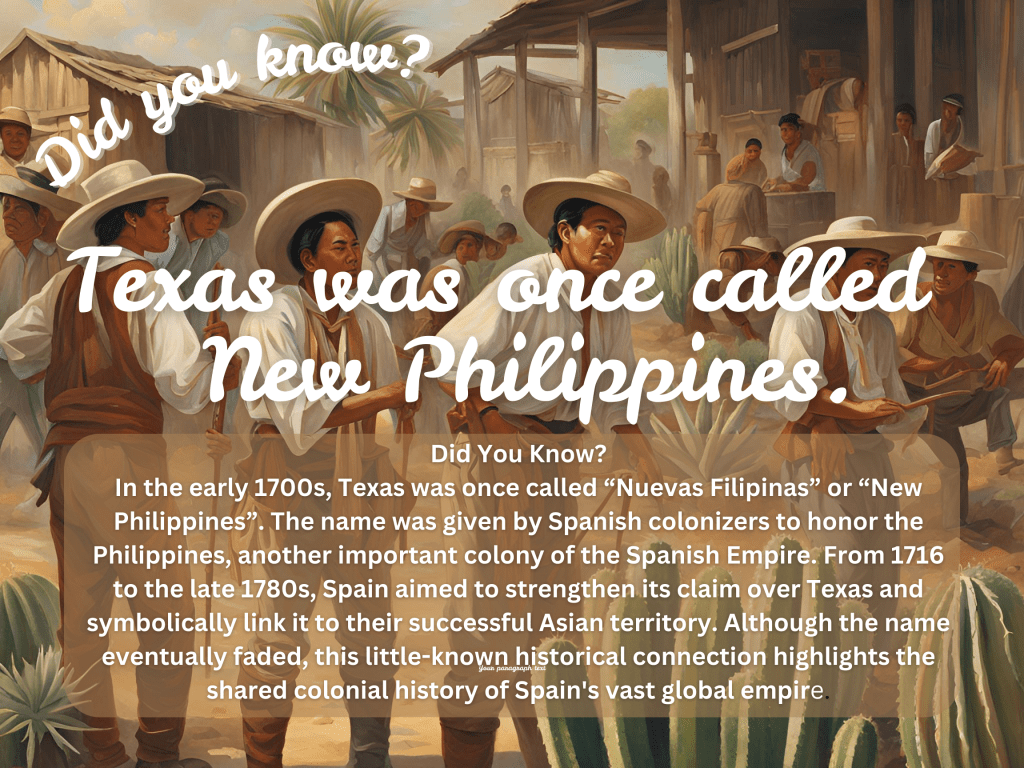
The name New Philippines was officially assigned in 1716 as Spanish explorers and missionaries sought to develop and fortify the province of Texas, which was part of New Spain (Mexico today). The decision to call it “New Philippines” reflected Spain’s ambitions to honor and replicate the success of its lucrative colony in the Philippine Islands, which had been under Spanish rule since the 16th century.
The Spanish Crown sought to strengthen its hold on Texas after increasing competition from French explorers in neighboring Louisiana. To solidify control, Spanish missions and presidios (forts) were established across East Texas, and it was during this period that the name New Philippines came into use. This name appeared in official Spanish documents to refer to the area as part of broader plans to bolster colonial presence in North America.
By the 1780s, the name New Philippines began to fade as the region increasingly became known simply as “Texas,” derived from the Caddo word Tejas, meaning friends or allies. The influence of New Spain gradually diminished as Texas evolved into its own distinct territory, setting the stage for its storied path toward independence and eventual statehood in the United States.
The brief chapter of Texas as “New Philippines” highlights the deep colonial ties between Spain’s territories in the Americas and Asia. Though largely forgotten, it is a fascinating reminder of the interconnected history of global exploration and empire building during the Spanish colonial era.
Sources:
Chipman, Donald E., Spanish Texas, 1519-1821.
Bolton, Herbert E., Texas in the Middle Eighteenth Century.
“Texas History Timeline” – Texas State Historical Association (TSHA).


 HOME: Balitang Texas
Leave a comment